
Detail · Style Journal 05 / 12
A Complete Guide to Shirt Collars
Point, spread, cutaway, button-down, band. The collar frames the face — choose it as carefully as the shirt itself.
The collar is the most important few square centimetres of a shirt. It sits closest to the face, frames the jaw, sets the angle of a tie and is the first thing anyone notices across a meeting table. Choosing a collar well means understanding its anatomy, the main styles and the simple logic that connects them to face shape, neckwear and occasion.
The anatomy of a collar
Before comparing styles, it helps to know the parts. The band (or collar stand) is the strip that wraps around the neck and carries the top button. The leaf is the part that folds over and is visible. The points are its tips. The spread is the distance between the points, and the point length is how far they extend from the band. Some collars also have collar stays, slim removable or sewn-in stiffeners that keep the points straight.
Most of what distinguishes one collar from another comes down to two variables: how wide the spread is and how long the points are. A narrower spread draws the eye downwards, while a wider spread draws it outwards. Higher bands look more formal and suit longer necks; lower bands feel more relaxed.
The dress collars: point, spread and cutaway
Three collars form the formal backbone of men's shirting. They differ mainly in how far apart the points sit, and that single variable changes the character of the shirt, the tie it wants and the face it flatters.
The point collar
The point collar has a narrow spread and relatively long points that angle sharply downwards. It is the most traditional business collar, and its vertical lines lengthen the face and neck. It suits men with round or broad faces particularly well, because the long, narrow points counter width.
A point collar pairs naturally with a slimmer tie knot, such as a four-in-hand, which fits neatly into the narrow space between the points. A large knot will push the points apart and look crowded. For a conservative office, interviews and men who prefer a classic look, a white or pale blue formal shirt with a point collar is impeccable.
The spread and semi-spread collars
The spread collar opens the points wider, revealing more of the tie knot and creating a broader, more confident frame. It is often regarded as the most versatile modern collar: smart enough for a suit and tie, yet still sharp worn open. A semi-spread sits between point and spread, and is perhaps the safest single collar a man can choose if he wants one style to cover everything.
Spread collars suit slim or long faces, adding visual width, and they work with fuller knots such as a half-Windsor. Under a jacket, they look especially polished, as the collar points sit neatly beneath the lapels rather than disappearing behind them.
The cutaway collar
The cutaway takes the spread further, with points swept back almost horizontally. It is a bold, distinctly European look that demands a substantial tie knot to fill the gap, or a deliberate open neck. Worn with a dark silk tie and a sharply cut suit, a cutaway is striking at evening events and receptions.
It is less forgiving than other collars. A cutaway can widen an already broad face, and when worn open without a jacket it may collapse unattractively. It is a collar for men who enjoy a more directional style and dress formally often.
Wing and club collars
Two rarer collars complete the formal family. The wing collar is a short, upright band whose small points fold outwards like tips of a wing; it belongs almost exclusively to the most formal evening dress, worn with a bow tie and a dinner suit or tailcoat, and looks out of place anywhere else. The club collar has rounded rather than pointed tips. It enjoyed wide popularity in the early twentieth century and survives today as a quietly distinctive choice with a slightly vintage flavour, handsome with a narrow tie and a three-piece suit, or worn open beneath a soft unstructured blazer. Neither is essential, but knowing them helps you recognise when an occasion, or a personality, calls for something beyond the usual.
The collar is where a shirt decides whether it is going to work or going out.
The button-down collar
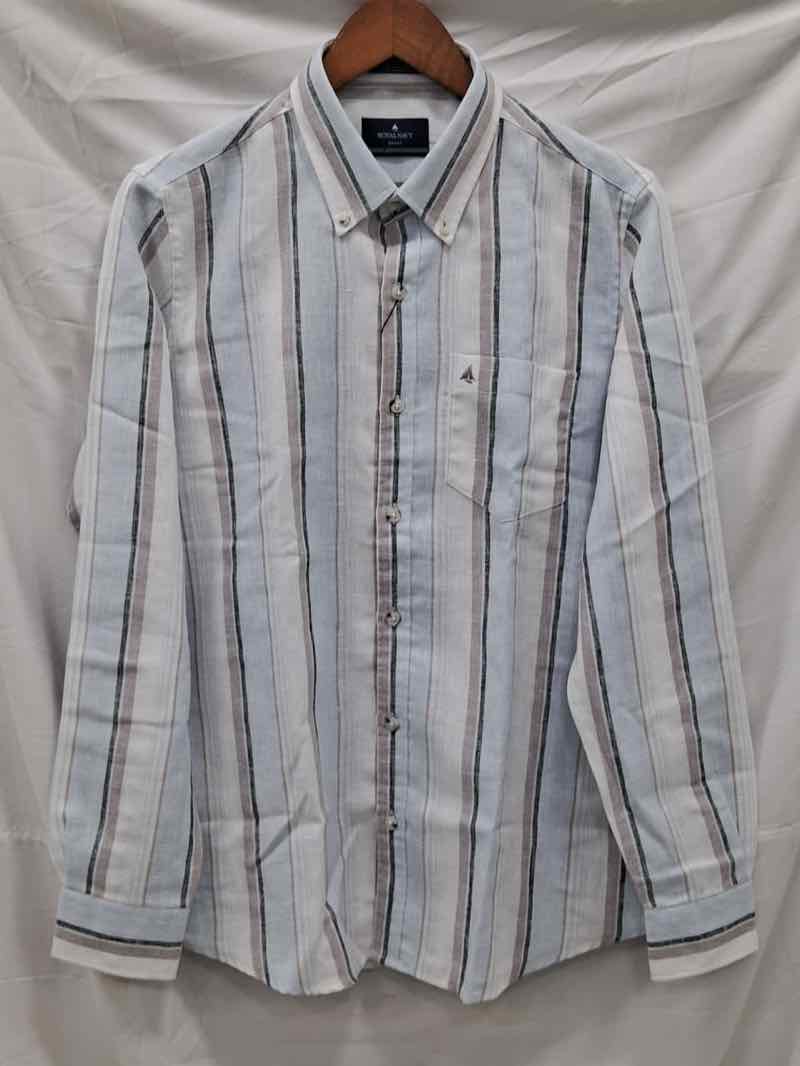
The button-down collar has small buttons that fasten the points to the body of the shirt. It is generally traced to sportsmen at the end of the nineteenth century who wanted their collars to stay put during play, and it has never quite lost that sporting ease. The fastened points create a soft roll as the collar curves towards the button, which is the hallmark of a well-made button-down.
The grey multi-stripe shirt shown here is a good example of where this collar belongs. Stripes and a button-down together read as smart casual: excellent for a business-casual office, a Friday, a working lunch or travel. Pair it with navy chinos or grey trousers and brown loafers, with or without a casual blazer. A knitted tie is acceptable, but button-down collars are traditionally not worn with formal suits or silk ties, and they should never be worn with the buttons undone.
The band collar
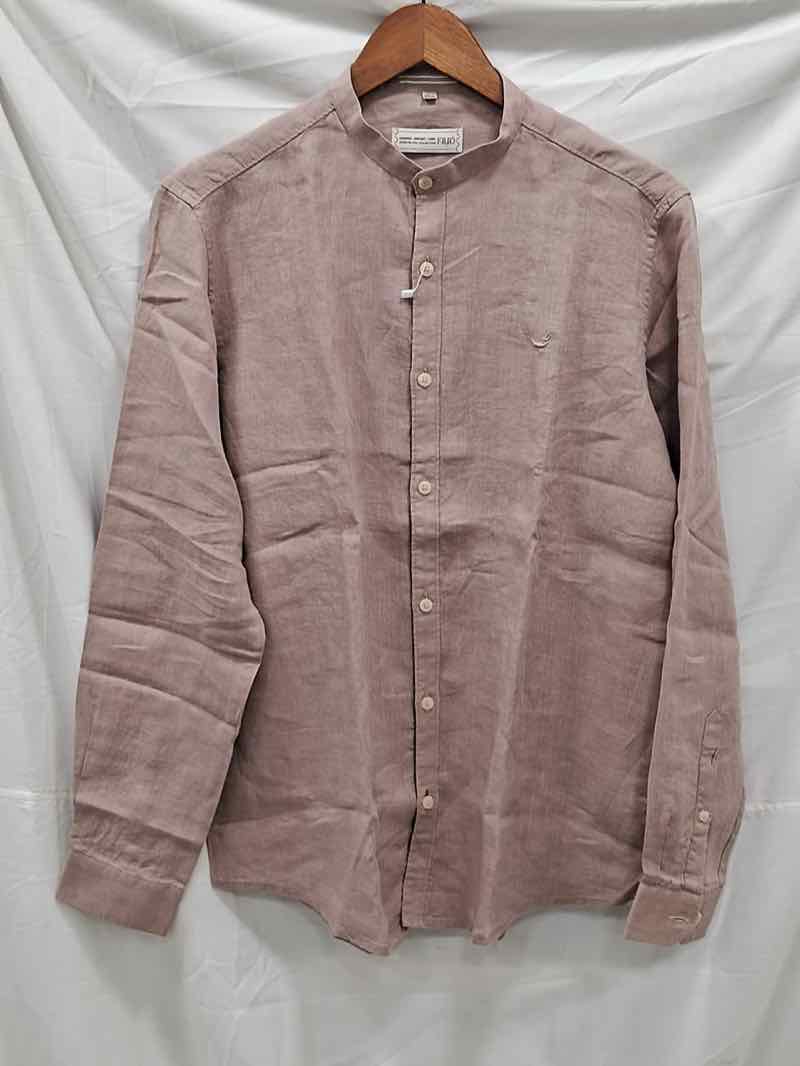
The band collar, sometimes called a mandarin or grandad collar, is simply the collar stand without a leaf. It has deep resonance in India, echoing the necklines of the kurta and the bandhgala, and it offers a clean, minimal look that feels both contemporary and rooted.
The dusty pink shirt pictured with this article shows the band collar at its best: soft colour, a clean neckline, no tie required. A band collar cannot take a tie, so it belongs to relaxed and celebratory settings rather than formal offices. Worn under a Nehru jacket or a lightweight bandhgala at a mehendi or sangeet, or alone with tailored trousers at an evening gathering, it is effortless and elegant. It also suits Mumbai's climate well, as there is less fabric around the neck.
Matching collar, face and tie
The principle of balance is simple: a collar should counter, not exaggerate, the shape of the face.
| Face shape | Flattering collar | Tie knot |
|---|---|---|
| Round or broad | Point, narrow semi-spread | Four-in-hand |
| Long or narrow | Spread, cutaway | Half-Windsor, fuller knots |
| Oval or balanced | Almost any style | Matched to collar spread |
| Angular jaw | Semi-spread with softer points | Four-in-hand or half-Windsor |
Proportion with the body matters too. Larger men generally look better in collars with slightly longer points, which keep scale with the frame; slighter men suit shorter, more modest points. Neck length is the third factor: a long neck benefits from a taller band, while a shorter neck is flattered by a lower band and a slightly open spread.
Collars by occasion
- Interviews and boardrooms: point or semi-spread, with a tie, ideally on one of the white formal shirts every wardrobe should hold.
- Everyday office: semi-spread or spread, tie optional depending on dress code.
- Business casual and Fridays: button-down, worn open.
- Evening receptions and formal dinners: spread or cutaway, with a dark silk tie or an open neck under a sharp jacket.
- Festive and family celebrations: band collar under a Nehru jacket, or a spread collar with a festive jacket.
For a wider view of how shirts and occasions match, explore our page on formal shirts for occasions and our formal shirt styling guide.
Checking collar quality and fit
A good collar should hold its shape through the day without looking rigid. When trying shirts, fasten the top button and slide two fingers inside the band: they should fit comfortably. Look at the points in the mirror: they should be symmetrical, lie flat against the shirt and not curl upwards. If the shirt is worn without a tie, the collar should stand cleanly around the neck rather than flopping onto the shoulders.
Look also at the stitching along the collar edge. Even, closely spaced stitching set neatly near the edge is a mark of careful construction, and it helps the collar keep a crisp profile wash after wash.
The frame for the face
Every collar tells the people around you something: tradition, confidence, ease or modernity. Once you understand the language, choosing becomes simple. To see these collar styles side by side and try them on, visit Options Mall in Juhu, Vile Parle West, and explore formal shirts in person.